
Key Points
-
Question: Is a dedicated virtual rounding team non-inferior to a traditional rounding team in delivering home care?
-
Finding: A virtual rounding team was associated with no differences in adverse events, escalation, 30-day readmission, or utilization.
-
Meaning: A dedicated virtual rounding team may not be as helpful a care model for a home hospital setting.
INTRODUCTION
Over 45 years ago, the idea of acute medical care in a home setting, or “Home Hospital,” was introduced.1 The foundation of this model was the belief that patients would be less exposed to the harms of hospitals, would recover faster due to increased physical activity, and have a more positive experience in the comfort of their own homes rather than in a brick-and-mortar hospital.2–5 With worsening acute care access, an aging population, and rising chronic diseases impacting all age groups, integrating home hospital is an imperative solution in many communities.6–11 Many home hospital provides hospital-level care, including twice daily nurse or paramedic visits, once daily provider (e.g., physician or advanced practice provider) visits, intravenous infusions, continuous monitoring, in-home imaging and bloodwork, 24/7 in-home response, and other care.1,12,13
Despite its benefits, home hospital is challenged by the logistics of providing care to a dispersed patient population. Some home hospital programs have providers in the home daily, some only have providers perform remote visits, and others have a hybrid approach where the care team chooses whether to see a patient in-home or remotely each day. Our program functioned in a hybrid format, but we sought to evaluate the association of creating a dedicated rounding team that only saw patients remotely. We hypothesized that a dedicated virtual rounding team would help reduce travel time and improve provider efficiency and experience, without forfeiting quality and safety.
METHODS
Setting
Our home hospital team provides twice daily in-home nurse or mobile-integrated health (non-emergency) paramedic visits, once daily physician or advanced practice provider visit (remote or in-home based on patient need), 24/7 continuous remote monitoring, 24/7 in-home urgent response team, and the ability to deliver hospital-level care including intravenous infusions, diagnostic testing (in-home labs, x-ray, and ultrasound), specialty consultation, and physical therapy. As a quality improvement project, we performed a controlled intervention to evaluate a dedicated virtual rounding team for the home hospital. The setting included patients admitted to one of five hospitals (Brigham and Women’s Faulkner [BWF], Brigham and Women’s Hospital [BWH], Newton-Wellesley Hospital [NWH]), Massachusetts General Hospital [MGH], and Salem Hospital [SLM]) between December 1, 2023, and March 1, 2024. Between December 1, 2023, and January 15, 2024, was the pre-implementation period. Between January 16, 2024, to March 1, 2024, was the implementation period. Our team considers patients on the “North” or “South” team depending on their home location. This division is created purely based on traffic patterns and how facile transport is in Boston. Patients on the North side were part of the intervention group, while those on the South Side served as the control group. The North side team, using only existing staffing, converted some of its provider staff (providers are physicians or advanced practice providers [physician assistants or nurse practitioners]) into a remote-only rounding role. Nurses or paramedics always remained in the home. There were no changes to the South side staffing.
Intervention
Providers’ schedules on the North team were restructured to allow for one provider each day on a rotating basis to be dedicated only to remote visits, instead of the typical hybrid approach where a provider would perform a combination of remote and in-home visits. A remote provider was given no specific training or tasks, other than to continue to evaluate and manage the patient by video. Patients were placed on the remote team only if none of the following exclusions applied: internet connectivity issues, cognitive disabilities, visual or hearing impairments, complex wound care requiring in-person evaluation within three days, first in-home visits post-ED, no in-person evaluation within the last three days with lack of progression, unanticipated medical issues requiring in-person evaluation, acute changes in mental status, goals of care conversations, or care plans necessitating in-person examination. If patients met these criteria, they would be moved to the remote provider team, where their visit would be facilitated by an in-home nurse or paramedic. The study design allowed crossovers from virtual rounding care to in-person care (usual care); crossovers were categorized as either planned or unplanned based on timing. A planned crossover included any crossover that occurred any day other than day three while an unplanned crossover was a crossover that occurred on day three.
Data Source and Quantitative Outcomes
Patient data were collected from the patient’s electronic health record. The primary outcome was an adverse event (AE) composite, expressed as the number of AEs per hundred patients. AEs in the composite included delirium, new C. difficile, new methicillin-resistant Staphylococcus aureus (MRSA), escalation, unplanned mortality, fall, and catheter-associated urinary tract infection (CAUTI). Hospital-acquired delirium was defined as one positive confusion assessment method (CAM) within 24 hours of negative prior CAMs with onset >=24 hours after admission. Hospital-acquired C. diff was defined as a positive stool lab test more than three days after admission, not present on admission. Hospital-acquired MRSA was defined as a positive lab test more than 3 days after admission with no positive MRSA lab test in the previous 12 months. Positive lab tests denoted as “previous MRSA,” or “known MRSA” were excluded as well. Escalation was defined as when a patient was transferred back to the brick-and-mortar hospital for at least 1 midnight. Unplanned mortality was defined as when the encounter discharge disposition included “expired.” A fall was documented in the flowsheet on our electronic health record. CAUTI was defined as a positive urine culture following two consecutive days of an indwelling urinary catheter. Secondary outcomes were length of stay and 30-day readmission. Exploratory outcomes included lab orders, imaging orders, and consultations.
Qualitative Outcomes
Qualitative provider data were collected from an asynchronous anonymous survey administered to providers after each week they served on the remote rounding team beginning January 16, 2024, during the seven-week period (eTable 1). The survey assessed provider experience with the model, covering patient load, visit duration, time management, preparation, adherence to virtual criteria, and perceived barriers. Responses were analyzed to identify themes and patterns using thematic and content analysis, providing insights into the effectiveness of the virtual rounding approach.
Statistical Analysis
Data from the electronic health record was analyzed using R (version 4.4.0) to identify discrepancies such as missing values, duplicates, and outliers. We employed a linear model ANOVA, the default test for continuous variables (mean and inter-quartile range) of groups that differ significantly from one another.14 If the variable being examined (Left-Hand Side) had two levels or groups, we simplified the ANOVA to a two-sample t-test. During the pre-implementation and implementation phases, we assessed baseline sociodemographic and patient characteristics like age, sex assigned at birth, race/ethnicity, partner status, primary language, education, and employment across North vs. South regions and virtual vs. usual care. We also evaluated baseline characteristics for primary (adverse event composite), secondary (length of stay), and exploratory outcomes (lab orders, imaging orders, consultations). For categorical variables and outcomes (escalation, 30-day readmission, new C. diff, unplanned mortality, delirium, CAUTI, and falls), we used Pearson’s chi-square test with a simulated p-value for a more precise analysis of counts and frequencies. Missing data were handled as a separate category for our analysis, as they comprised less than 5% of the observations. A two-sided simulated p-value of less than 0.05 was considered significant.
We used a multivariable linear regression model for a difference-in-differences (D-I-D) analysis to assess virtual rounding’s association with our outcomes after its implementation.15 We conducted a D-I-D analysis with a significance level of p-value < 0.05. The composite outcome variable created included adverse events per 100 patients. We created two indicator variables, one for patients from North-side hospitals and one for patients from either hospital after January 15, 2024. We created an interaction term to assess the combined effects of these variables. In the Difference-in-Differences model, the coefficient of the interaction term indicates the estimated effect of the intervention, which is the change in the likelihood of the outcome attributable to the intervention, independent of baseline differences and general time trends .16 When comparing the pre-and post-period outcomes of individuals on the virtual rounding team to those who were not, the interaction term predicts the difference in differences.16 We fit six adjusted and non-adjusted additive probability models for each potential outcome, adjusting for covariates like race/ethnicity, and education.16
Ethics
This study was conducted as a quality improvement project (local service evaluation) and did not require formal Institutional Review Board (IRB) approval. Oversight was provided through the institution’s existing clinical and operational governance structures, and ethical standards- including patient confidentiality and data protection were maintained in accordance with institutional policies. Individual informed consent was not required either being a quality improvement project participants received only the home hospital remote care virtually.
RESULTS
Patient Characteristics
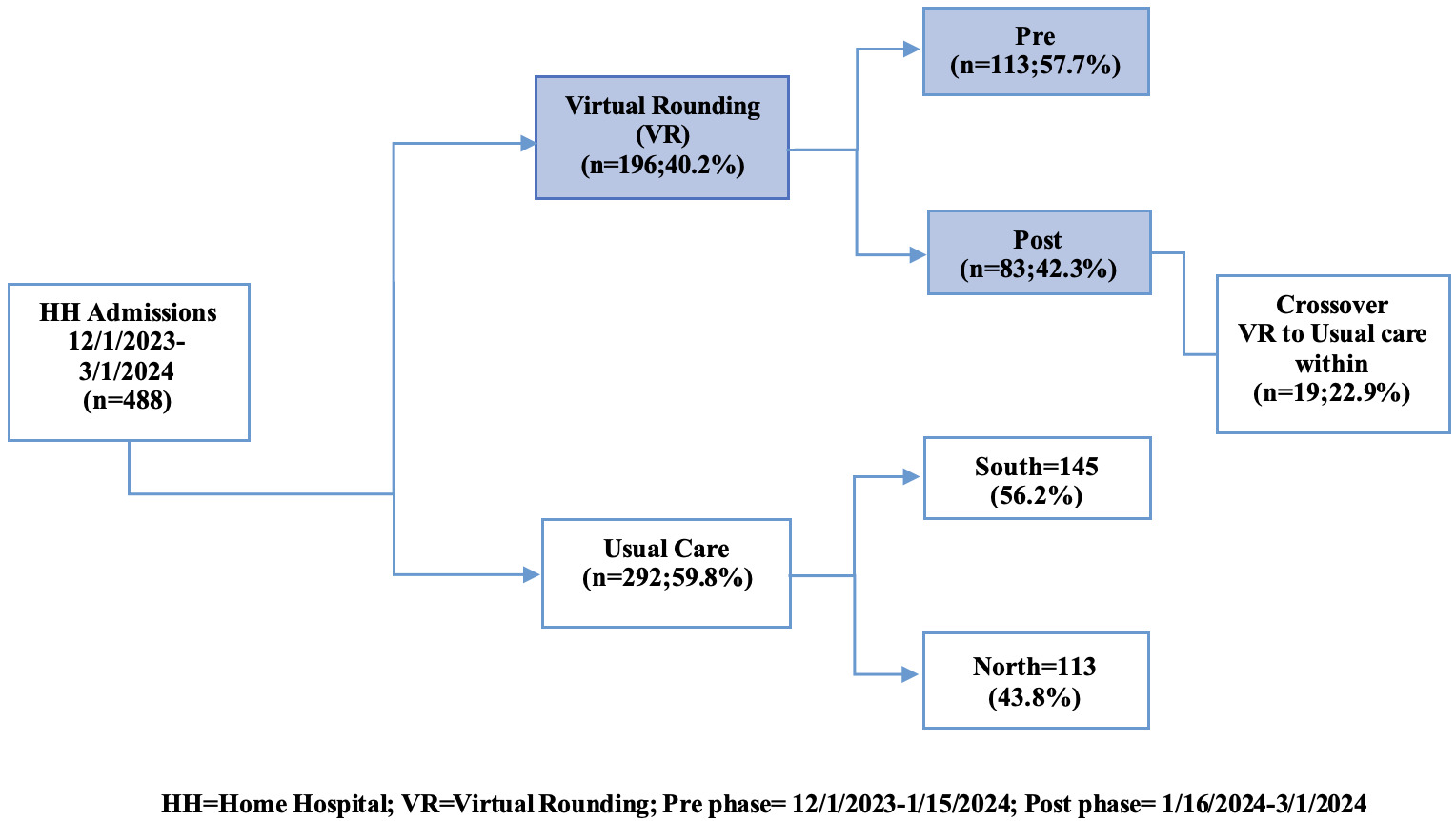
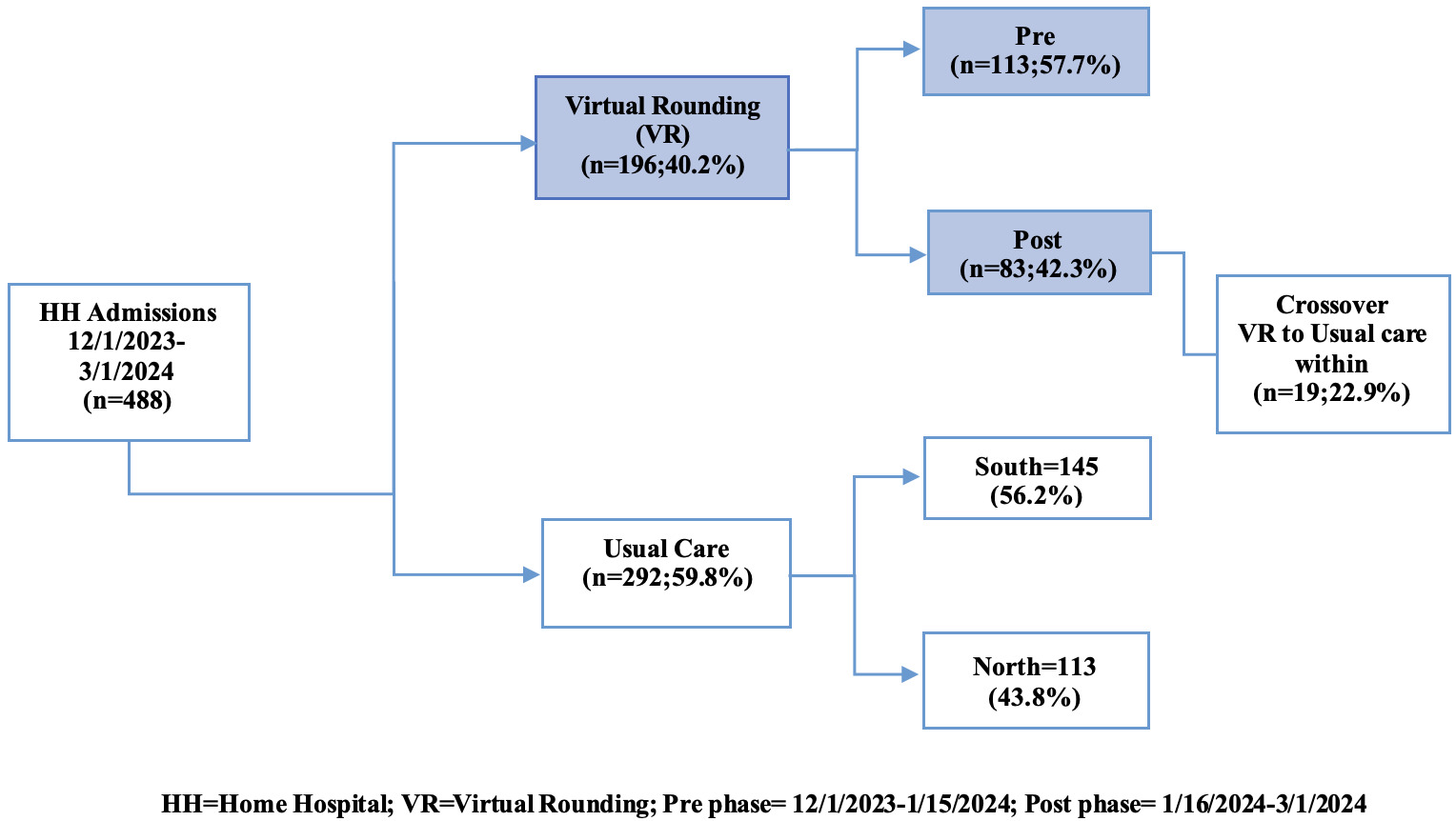
We studied 230 patients, with 147 on the South side and 83 on the North side (Table 1.A). On the South side, the median age was 79 years, 59.2% were female, many were partnered (44.9%), preferred English (87.1%), and were retired (64.6%). The North side was similar, except for race/ethnicity and education status. For example, the South side was 10.9% black race/ethnicity, versus 1.2% on the North side. The South side received less education.
Crossover
We observed a total of 19 (23%) crossovers out of 83 patients (Table 1.B). Most crossovers occurred when a virtual physical examination was insufficient and in-person physical examination was required.
Adverse Events
Few adverse events were detected in both groups. No episodes of new C. difficile, new MRSA, unplanned mortality, delirium, or CAUTI were noted in either group (Table 2 and eTable 2). There was no significant difference in the composite adverse event rate (virtual, 3.54% vs 3.61%; usual care, 11.7% vs 12.2%; adjusted D-I-D, -1.05 (95% CI, -12.2 to 10.1). There was no significant D-I-D for escalation (virtual, 2.7% vs 3.6%; usual care, 8.3% vs 12.2%; adjusted D-I-D, -3.6 (95% CI, -13.3 to 6.1). There was no significant D-I-D for 30-day readmission (virtual, 12.4% vs 14.5%; usual care, 11% vs 6.8%; adjusted D-I-D, 6.8 (95% CI, -4.5 to 18.2), although this may approach a clinically significant change.
Utilization
After adjustment, there was no significant D-I-D for any utilization parameters (eTable 2 and Table 2). Both between and within group comparisons had little clinically important difference, except the virtual rounding team appeared to utilize consultation at a higher rate both before and after the intervention.
Virtual Rounding Provider Satisfaction Survey
We collected feedback from 43 providers (brick-and-mortar admitters [providers whose shift was to admit patients at the hospital] – 4, charge nurses -1, collaborators -4, traditional in-home rounders -19, and virtual rounders- 15). All providers reported utilizing the exclusion criteria to allocate patients to the virtual rounding team. The largest barriers to using the virtual rounder were clinical judgement (i.e., concern that the patient needed the higher level of in-home care) and continuity of care (i.e., desire not to disrupt continuity). Of those who delivered the virtual rounder care, 73% were satisfied or very satisfied with their shift, 93% reported having enough time in the day, and 80% felt better prepared being in a stationary place. In contrast, traditional rounders felt more burdened by the loss of their colleague in the field, who instead was now rounding virtually. Traditional rounders cited a major loss in the continuity of care, challenging schedules, and the need to reshuffle, worsening geographic assignments given there were fewer field-based rounders, and an increase in the acuity of their patient load. Both virtual and traditional rounders noted that virtual assessment was inferior and incomplete compared to in-home assessment, where a virtual assessment one day would necessitate an in-home assessment the next day because of the incomplete nature of the virtual assessment. Overall, providers were not in favor of continuing with the dedicated virtual rounder model, instead favoring the prior hybrid model of choosing the modality of one’s visits in a patient-tailored manner.
DISCUSSION
In a quasi-experimental mixed-methods evaluation of select patients receiving home hospital care in a model that involved a dedicated virtual rounder alongside in-home rounders versus usual home hospital care involving all hybrid rounders who could choose to see their patients in-home or by video, we found no statistically significant differences in adverse events, escalation, 30-day readmission, or utilization including laboratory orders, imaging orders, and consultations. Our qualitative evaluation suggested providers strongly preferred the hybrid approach, citing decrements in continuity, worsening workloads and travel times for in-home providers, and concerns with incomplete assessment by video.
There are likely several reasons for this null quantitative association. First, our virtual rounder model required patients to be seen in-person if they were not progressing. This safety valve likely maintained quality and safety compared to the usual care group. Our prior work showed the importance of allowing for an in-home visit in patients being seen remotely.17 Second, patients who could be chosen for virtual rounding were, by design less complex and less acutely ill than the general home hospital population. These patients are generally less likely to have adverse events, and so it is unsurprising that adverse event rates were low and not associated with a difference in difference. It remains unknown whether more complex patients would have a similar association. Third, our usual care group allowed for providers to choose to see their patients in-home or remotely. This may be a reason for similar utilization rates in labs, consults, and imaging, as the usual care group rounders may have relied on surrogate markers of progression, such as labs and imaging at a similar rate as virtual rounders.
Our qualitative findings highlighted the importance of continuity in acute care and the unintended consequences of concentrating on less complex patients with a single provider to the detriment of the other team members. The virtual rounders reported a positive experience, but their colleagues in the field did not. All providers recognized the limitations of remote assessment due to problems with connectivity (e.g., image and sound quality), accessibility (e.g., physical and behavioral impairments; language barriers), and the lack of some modalities of the physical exam, such as auscultation. This dissatisfaction with the model indeed caused our program to terminate the virtual rounder model.
Our work builds on the evidence base for remote home hospital care.18 An international survey recently demonstrated that some programs operate only with remote providers.19,20 Entirely remote provider models have been associated with high patient experience and provider experience.21,22 Remote models may function well for coronavirus disease 2019 and various others.23,24 These are important contributions to the model, yet it is likely that the outcomes of fully remote programs do not mirror those with more in-home components.25 It is also likely that we are not yet harnessing all of the remote tools and sensors that we can to improve remote care.26–28
Our analysis has limitations. First, this is a quasi-experimental evaluation from which causation should not be inferred. Second, although we were able to adjust for multiple sociodemographic characteristics, unmeasured confounding may affect our results. Although a D-I-D approach is robust, this still remains a quasi-experimental evaluation. Third, our cataloguing of adverse events was purely electronic. Manual chart review may have identified more adverse events. Due to our methodology, we could not measure adverse events such as medication errors or care coordination errors. Fourth, it is hard to explain some of the changes in the control group, such as the escalation and readmission rate, although this may simply be explained by chance of variability. This underscores the need for robust quasi-experimental analyses such as this, instead of single-arm descriptive evaluations, and prospective randomized controlled trials in the future.29Fifth, the increased use of remote review could introduce detection bias, particularly for outcomes such as delirium that may be less readily identified without in-person assessment.
CONCLUSION
A dedicated virtual home hospital rounder alongside in-home rounders versus usual home hospital care treated less acutely ill patients and was not associated with differences in adverse events, escalation, 30-day readmission, or utilization, but providers have a strong preference for usual care.
Funding Statement
Internal funding
Data Sharing Statement
All authors had full access to all of the data (including statistical reports and tables). The study data may be available to interested parties by contacting the corresponding author.
Conflicts of Interest
-
Levine:
-
Royalties: Biofourmis
-
Fees: The MetroHealth System
-
Scientific Advisor: Feminai
-
-
All other authors have nothing to disclose
Author Contributions
-
Shaikh and Ssemaganda had full access to all of the data in the study and take responsibility for the integrity of the data and the accuracy of the data analysis.
-
Study concept and design: Levine.
-
Acquisition, analysis, or interpretation of data: All authors.
-
Drafting of the manuscript: Shaikh.
-
Critical revision of the manuscript for important intellectual content: All authors.
-
Statistical analysis: Ssemaganda.
-
Administrative, technical, or material support: Shaikh.
-
Study supervision: Levine.
Supplement tables, survey, and figures uploaded as separate attachments.