
INTRODUCTION
As the global population of older adults grows, healthcare systems must address their uniquely complex medical, cognitive, physical, and social needs.1 Age-Friendly Health Systems (AFHS) is an initiative of the Institute for Healthcare Improvement (IHI) and the John A. Hartford Foundation which aims to improve care for older adults through an evidence-based framework known as 4Ms: What Matters, Medications, Mentation, and Mobility.2 Specific goals within 4Ms include prioritizing a patient-centered approach; managing polypharmacy; identifying depression, delirium, and cognitive impairment; and promoting safe mobility.2 Implementation of 4Ms has been associated with improved outcomes and satisfaction, reduced healthcare-related harm, and fewer rehospitalizations and emergency department visits.1,3
Integrating Age-Friendly Care across the entire care continuum is critical, particularly in hospital-at-home (HaH) programs, an innovative care delivery model that provides hospital-level care in patients’ homes. In two randomized trials conducted in the UK, HaH with comprehensive geriatric assessment was shown to be a safe and cost-effective alternative to inpatient care for older adults, with comparable clinical outcomes.4,5 HaH has experienced exponential growth in the United States since the Centers for Medicare & Medicaid Services implemented the Acute Hospital Care at Home waiver in November 2020. As of January 2026, 373 hospitals had obtained the waiver across 37 states.6 These programs have been integral in meeting the acute care needs of older adults, as nearly 90% of Americans wish to “age in place” at home.7 HaH programs are safe and satisfactory for older adults and mitigate hospital-associated risks including infection and functional decline.8,9
The United States Veterans Affairs (VA) Health System serves an aging population; nearly half of the system’s patient population is aged 65 or older.10 Within the VA, HaH programs are referred to as Hospital-in-Home (HIH). However, for clarity and consistency, we use HaH throughout this manuscript. As of 2025, 12 VA Hospitals have implemented HaH programs; however, the extent to which these programs incorporate Age-Friendly Care is unknown. Given that HaH was originally developed for older adults, evaluating the integration of AFHS and identifying barriers to implementation are crucial. Such insights may inform improvements in HaH programs, with the goal of advancing acute home care globally.
Objective
To assess VA HaH Medical Directors’ attitudes, current practices, and perceived barriers to implementing the 4Ms framework of Age-Friendly care.
METHODS
All VA HaH Medical Directors (n=12) were emailed an anonymized electronic survey, which was created with input from geriatrician and HaH leaders (suppl_1). The survey comprised 50 items assessing beliefs, current practices, and perceived barriers to implementing care across each Age-Friendly domain. Beliefs about the importance of providing age-friendly care were assessed using a 5-item Likert scale ranging from “not at all important” to “extremely important.” Responses were collected from February to June 2023. Descriptive statistics were used to summarize survey responses. A non-research determination was obtained from the institutional review board.
RESULTS
Nine of twelve HaH Medical Directors completed the survey. Seven of nine programs had been operational for at least three years with an average daily census of 12 and approximately 153 patients enrolled per year. Seventy-seven percent of respondents were familiar with Age-Friendly 4Ms, and 88% estimated that at least half of patients admitted to their HaH program were aged 65 and older. Additional program demographics are reported in Table 1.
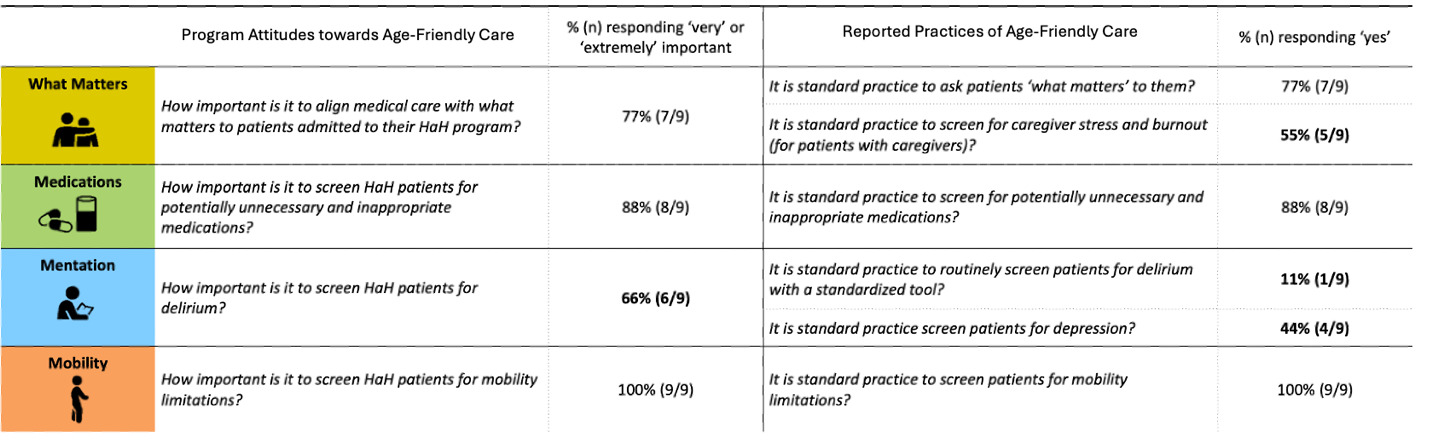
Reported attitudes and practices pertaining to 4Ms are summarized in Figure 1. A strong majority of program directors believe it is ‘very’ or ‘extremely’ important to assess mobility, medication, and what matters to patients.
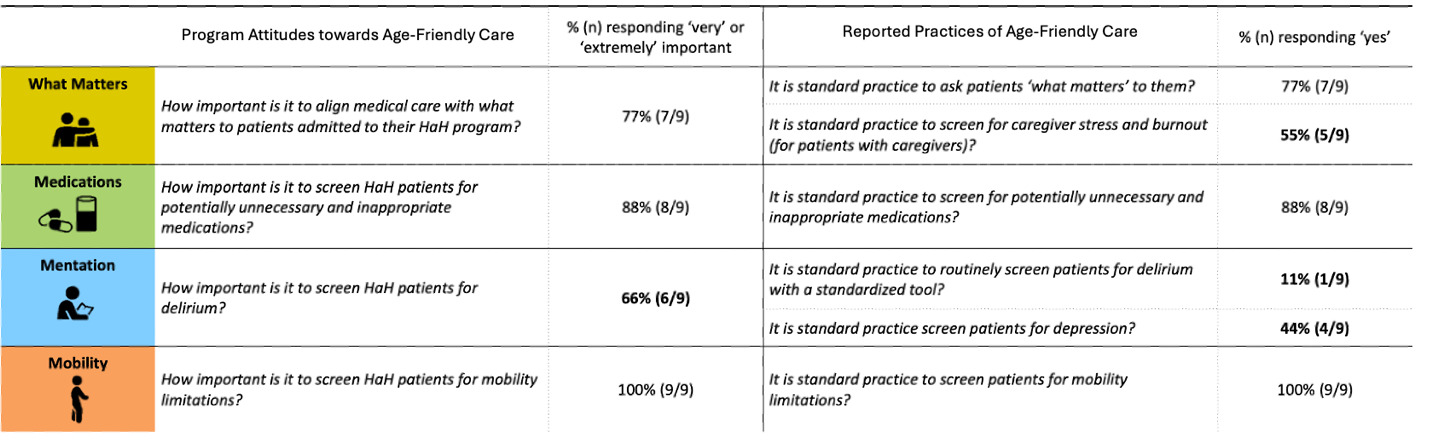
However, a smaller proportion (66%) endorsed the importance of delirium screening, and only 11% reported routinely doing so. Reported barriers included lack of knowledge (11%), the belief that it is less relevant to HaH patients than in-hospital patients (33%), time burden (11%), and staff resource burden (11%).
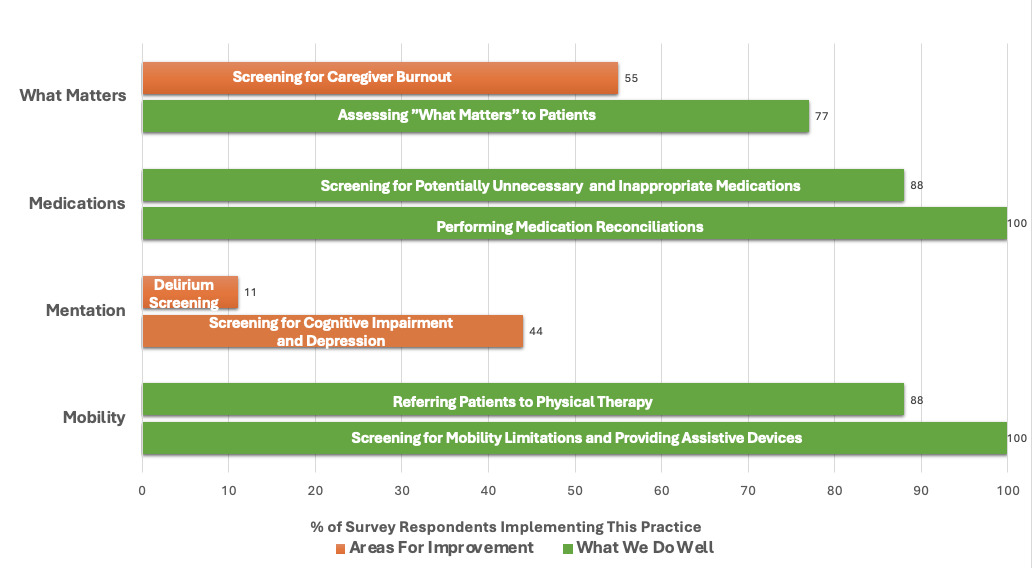
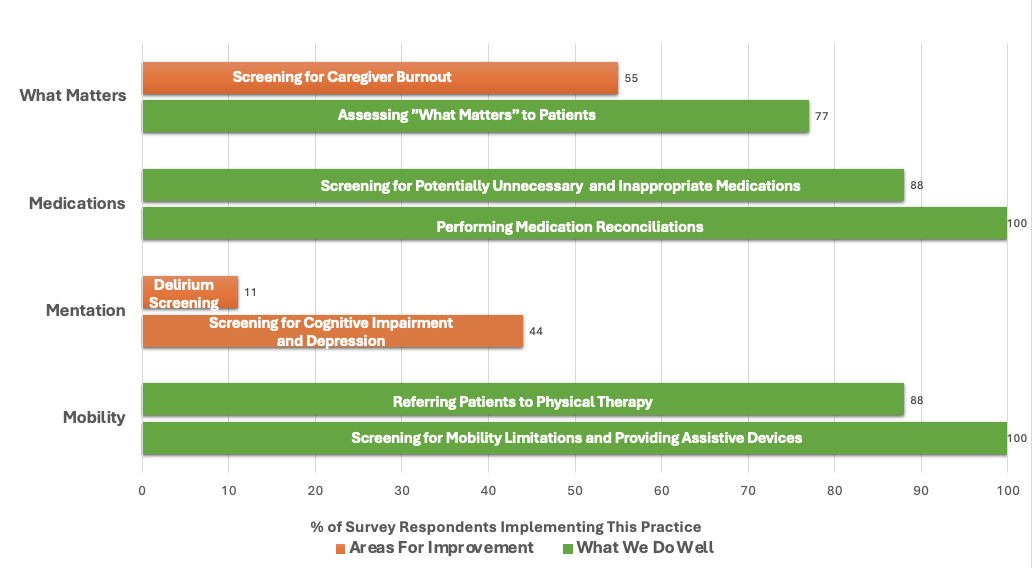
Less than half of programs routinely screen for cognitive impairment (44%) and depression (44%). All programs endorsed conducting mobility assessments, although only one reported utilizing a standardized tool to screen for mobility issues (STEADI falls screening questionnaire), while others relied on provider observation. Figure 2 summarizes strengths and potential areas for improvement of Age-Friendly care in HaH.
DISCUSSION
While over two-thirds of VA HaH Medical Directors confirmed their knowledge of and belief in the importance of AFHS in HaH programs, this survey highlighted notable gaps in the Mentation domain, particularly in screening for delirium, cognitive impairment, and depression. Therefore, this study has helped elucidate AFHS uptake in HaH which is crucial for optimizing care for older adults.
The most cited barrier to delirium screening was the perception that it is less relevant in HaH patients, a view supported by some but not all prior studies.9,11–13 There is no formal consensus on the appropriate frequency or tools for delirium screening in HaH. For in-hospital patients, AFHS recommends screening every 12 hours.14 However, screening HaH patients may be limited by the frequency of visits. An alternative approach is caregiver-led assessments utilizing tools such as the Family Confusion Assessment Method (FAM-CAM) which has demonstrated strong agreement with the interview-rated Confusion Assessment Method (CAM).15 Nursing staff can offer additional support, using brief, routinely administered screening tools, such as the CAM or brief-CAM.15
Patients should be screened for depression and cognitive impairment as these conditions can significantly affect their ability to participate in a HaH program and increase their delirium risk. It is estimated that over 20% of the population aged 75 and older has mild cognitive impairment, which is associated with higher hospitalization rates.16 Given that HaH patients may lack continuous supervision, identifying cognitive impairment is essential to tailor caregiving needs. Evidence-based screening tools include the Mini-Cog, Montreal Cognitive Assessment, or Mini-Mental Status Exam.14
Our survey identified key barriers to implementing AFHS in the HaH setting, including limited time and staff, lack of knowledge, and perceived irrelevance. These findings align with a recent review of 4Ms in clinical settings other than HaH, which highlighted common challenges such as inadequate infrastructure, insufficient training, lack of clinician buy-in, and time constraints.17 Identified facilitators included leadership and clinician buy-in, training opportunities, and embedment into electronic health records (EHR) and clinical pathways.17
As HaH expands within the VA and globally, embedding Age-Friendly principals into workflows is essential. Strategies include leveraging EHR tools, developing specialized training for HaH providers, and incorporating remote patient monitoring initiatives such as caregiver assessments. Furthermore, systems-level buy-in is necessary to ensure that 4Ms are not only assessed but are actively used to guide care and improve outcomes.
Study strengths include high response rate and the first reported data on AFHS in the context of HaH in the VA. Limitations include small sample size and generalizability to programs outside the VA. In addition, our study focused on the 4Ms framework described by the IHI and adopted by the VA. We acknowledge that others have adopted a 5Ms framework with the addition of Multicomplexity.18 Future studies should explore a 5Ms framework, focus on developing guidelines for delirium screening in the HaH setting, and study the impact of implementing Age-Friendly Care on patient outcomes globally.
CONCLUSION
Incorporating the 4Ms framework into VA HaH presents an opportunity to enhance quality of care for older adults. Continued efforts to address gaps in the mentation domain will be pivotal for achieving Age-Friendly HaH care.
Funding Statement
This material is the result of work supported with resources and the use of facilities at the VA Boston and Cincinnati VA. No specific funding was received for this work. The views expressed in this article are those of the authors and do not necessarily reflect the position or policy of the Department of Veterans Affairs or the United States government.
Data Sharing Statement
Not Applicable
Conflicts of Interest Statement
BL discloses receiving personal consulting fees: Chartis Healthcare, the Aligned Health Group, the Kenes Group, and the West Health Institute. Stock options: Member of clinical advisory boards to Honor Care, Dispatch Health, Pager Health. Honoraria: Board of directors of the American Board of Internal Medicine Foundation. Dr. Leff serves as executive editor of the Journal of Advanced Home Medicine. This material is the result of work supported with resources and the use of facilities at the VA Boston and Cincinnati VA. Medical Center. The contents do not represent the views of the U.S. Department of Veterans Affairs or the United States Government.
Author Contributions
Conceptualization: SKJ, SP, BL; Data Curation: SKJ, SP; Formal Analysis: SKJ, SP, AA, BG; Funding acquisition: Not Applicable; Investigation: SKJ, SP, AA, BG; Methodology: SKJ, SP, BL; Project administration: SKJ; Resources: SKJ; Software: SKJ, SP; Supervision: SKJ, BL; Validation: SKJ, SP, AA, BG; Visualization: SP, AA, BG; Writing – original draft: SP, AA, BG; Writing – review & editing: SP, AA, BG, BL, SKJ