
Abbreviations: Hospital at Home (HaH), Alternatives to Traditional Hospital Care Offered in Monitored Environments (AT-HOME), Brick and Mortar (BAM)
Key Points
Question
How do clinical outcomes for patients admitted to Victoria’s HaH program compare with outcomes for matched BAM patients?
Findings
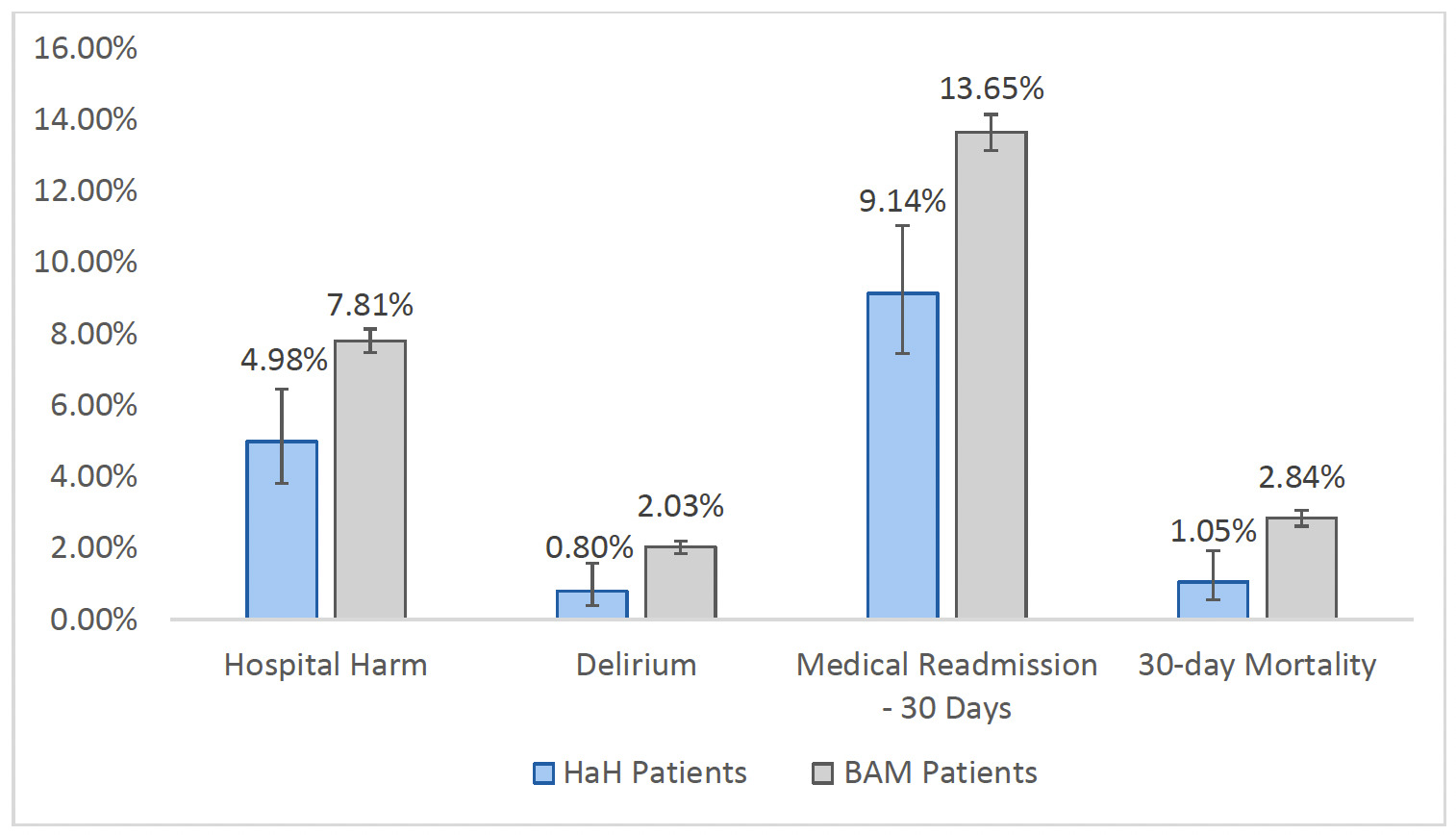
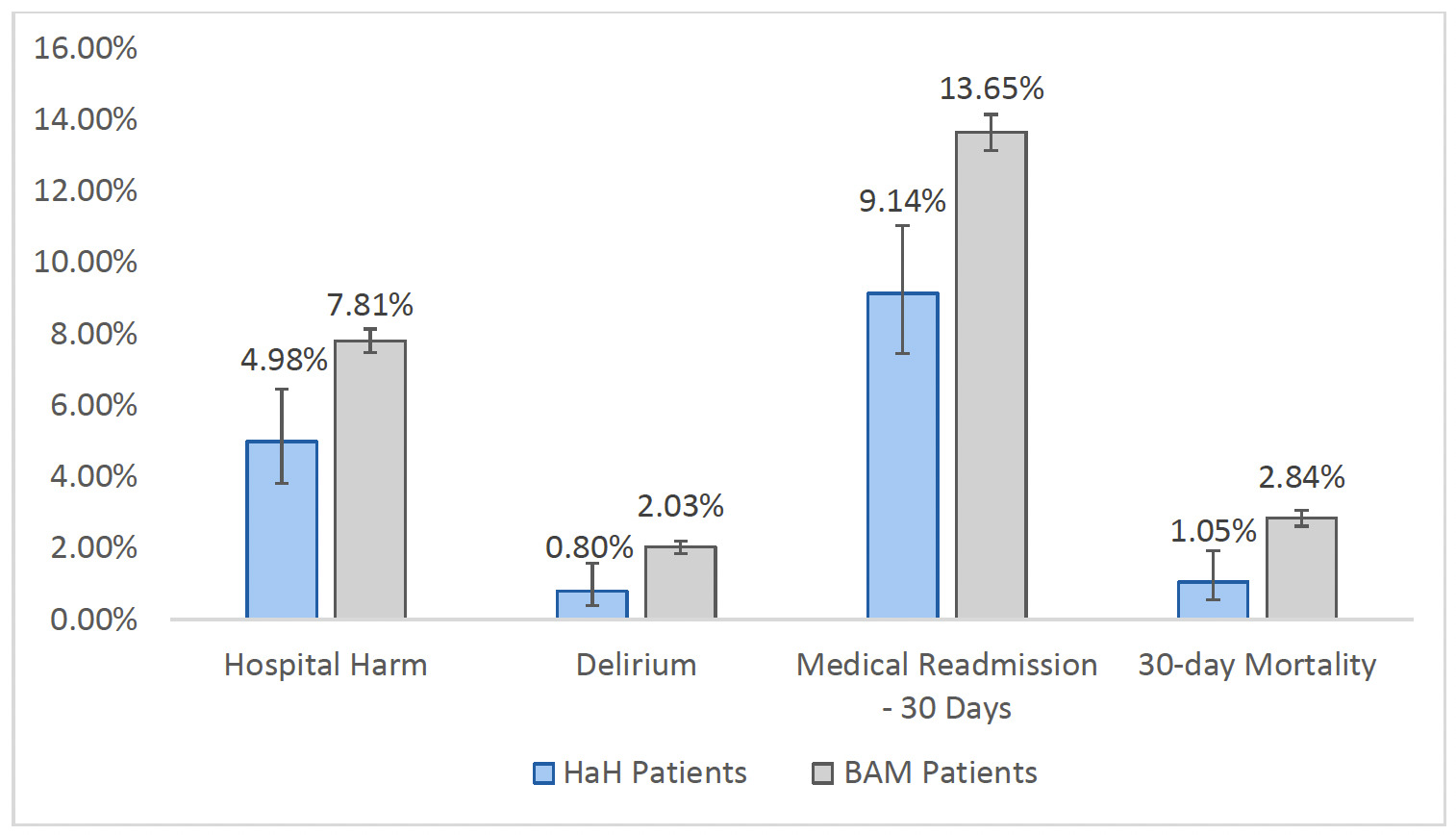
In this matched cohort study of 1,129 HaH patients compared with BAM patients, HaH care was associated with lower rates of hospital harm (5.0% vs 7.8%), lower 30-day readmissions (9.1% vs 13.7%), and lower 30-day mortality (1.0% vs 2.8%), with a number needed to treat of 56 to prevent one death. HaH patients experienced fewer cases of hospital-acquired delirium but a higher incidence of falls. The actual-to-expected length-of-stay ratio was higher for HaH patients.
Meaning
Hospital at Home appears to be a safe and effective alternative to conventional hospitalization in Canada, achieving comparable or improved clinical outcomes across several key measures. These findings support the ongoing integration and expansion of HaH models within the Canadian healthcare system.
Introduction
Hospital at Home (HaH) is a model of health care delivery that provides acute care in the patient’s home. While there are many randomized controlled trials showing the safety of HaH compared to BAM hospitalization,1–4 data on Canadian HaH programs are lacking. HaH in Canada was piloted in Ottawa and Toronto, and subsequently a sustainable HaH service was started in Calgary Complex which is still in operation.
In spite of these early programs, HaH was not widely known in Canada until the COVID-19 pandemic sensitized health care decision makers to its potential as an alternative to brick-and-mortar (BAM) hospital admission. The HaH program in Victoria, British Columbia was only the second HaH program in Canada when it began in 2020 as part of the British Columbia Ministry of Health’s COVID-19 Response Plan. In this study, our objective was to analyze the clinical outcomes of the Victoria HaH program during its first three years of operation.
Victoria HaH Program Model
The program operates as a round-the-clock inpatient unit whose mandate is to substitute for BAM hospitalization. It accepts medical and surgical referrals from physicians caring for adult patients at two local tertiary care hospitals. A referral triggers an in-person assessment by the HaH Physician and Nurse Leader. Patients who meet the eligibility criteria (Table 1), and who consent to HaH, return home from the hospital under the care of HaH.
HaH patients retain their inpatient status at the hospital. Inpatient status gives the patient access to hospital-based resources, such as medications, imaging tests and specialist consultations. If the patient’s condition changes such that either the patient, the caregiver or the program no longer considers the home a safe treatment location, the patient’s care is “escalated” to an inpatient ward; the Emergency Department (ED) is only used in the event of a true emergency.
HaH patients receive at least one home visit a day by a Registered Nurse. In addition to performing hands-on care, the nurse can administer intravenous medications and take blood and other samples. The HaH physician (a Family Medicine Hospitalist) reviews the patient daily, either virtually (by phone or video) or in-person. Patients and their caregivers are taught how to submit vital signs electronically on an agreed-upon schedule. Two HaH nurses and one HaH physician are on call after hours for overnight issues, and provide virtual or in-person visits as required.
Methods
The study cohort was drawn from the Discharge Abstract Database (DAD), a national repository of clinical and demographic data on hospital discharges, including HaH, managed by the Canadian Institute for Health Information (CIHI).5 The cohort was identified using study inclusion and exclusion criteria (Table 2) that aligned with the HaH program’s patient eligibility criteria (Table 1). All patients in the study cohort had been admitted to the referring hospitals between November 2, 2020 and September 30, 2023, were aged 18 or older, and had documented Family Medicine hospitalist involvement. Patients with an acute stroke, active psychiatric disorder or active substance use disorder were excluded from the study cohort.
Unlike many HaH studies that evaluate admission avoidance and early facilitated transfer separately, all HaH cases were analyzed as a single group because the program operates as a hybrid model. Quality outcome indicators specific to admission avoidance (e.g. time in ED) were excluded.
A straightforward cohort comparison was conducted between the HaH and BAM groups. For most outcomes, differences were evaluated using two-sample tests of proportions (chi-squared tests). No formal matching (e.g., exact matching, propensity scores, or frequency matching) was performed. Baseline characteristics were compared to assess group comparability.
For readmissions, adjusted outcome rates were calculated using coefficients from validated national statistical models developed by CIHI, representing an indirect method of standardization. Risk factors included age, sex, and selected pre-admission comorbid diagnoses, as defined by CIHI and applicable to the readmission indicator. Differences between groups were then evaluated using two-sample tests of proportions applied to the adjusted rates.
The Actual Acute Length of Stay to Expected Length of Stay (A/E LOS) ratio was calculated separately for each group. Ratios greater than 1 indicate longer-than-expected LOS and ratios less than 1 indicate shorter-than-expected LOS. No formal statistical comparison was performed between groups; 95% confidence intervals were calculated using Byar’s approximation.
This analysis did not include adjustments for clustering, site variation, or hospital-level factors. Group comparability was evaluated by comparing baseline characteristics prior to adjustment and through model diagnostics for the readmission outcome.
This review was granted an ethics exemption by the Island Health Research Ethics Board, as it qualifies as a Quality Improvement (QI) review, and does not constitute research involving human participants as defined by the Tri-Council Policy Statement: Ethical Conduct for Research Involving Humans (TCPS 2). A waiver of informed consent was granted as this study was a retrospective review of de-identified data, posing no more than minimal risk to participants.
Results
We identified 25,624 DAD abstracts that met the study inclusion and exclusion criteria, 1129 (4.2%) of which were HaH. The HaH group and the matched BAM cohort did not differ by age (median=75 vs 77, respectively), gender (51.1% female vs 53.4%, respectively), Charlson Comorbidity Index (CCI)6or average lab orders per day. The CCI is a validated method used to categorize patient comorbidities based on their impact on mortality risk.6 A table summarizing baseline characteristics for both groups is provided in Table 3.
HaH may be divided into two subtypes: “admission avoidance,” in which the patient is transferred to HaH directly from the community or the ED, and “early facilitated transfer,” in which the patient is transferred to HaH from the hospital ward. Seventy-five percent of the HaH cases were early facilitated transfer, and the remaining 25% were admission avoidance.
Hospital Harm is a measure of occurrences of harm in acute care that potentially could have been prevented by evidence-informed practices. Hospital Harm was significantly lower for patients in the HaH group (5.0%) than in the matched BAM cohort (7.8%) (two-proportions z-test, χ2= 12.191, p-value= 0.0002). Hospital-acquired delirium, a subset of Hospital Harm, was significantly lower for HaH patients (0.8% vs. 2%) (two-proportions z-test, χ2= 7.7934, p-value= 0. 0002). Falls, however, were significantly higher for HaH patients (20.4 per 1,000 vs. 8.2 per 1,000) (two-proportions z-test, χ2= 18.179, p-value=2.011e-05).
The Length of Stay to Estimated Length of Stay ratio (ALOS/ELOS) can be used as a metric of acute care efficiency. It is the ratio of actual hospital LOS to the CIHI-expected LOS, adjusted for disease complexity and patient risk factors, where a LOS/ELOS of 1 indicates a hospital stay of expected duration. Since CIHI includes HaH days as part of the patient’s hospital LOS, the ALOS/ELOS ratio can be compared between HaH patients and hospitalized patients. This analysis found that HaH provided care for a longer duration of time than BAM hospitalization. Specifically, the ALOS/ELOS ratio for HaH patients was 1.59 (95% CI: 1.55–1.62) compared to 1.19 (95% CI: 1.18–1.19) in the BAM cohort. The difference cannot be explained by a higher proportion of long-stay outliers in the HaH group, as this proportion was the same between the HaH group and the BAM cohort (7.4% vs. 7.6%, respectively).
The 30-day post-discharge readmission rate was analyzed separately for medical and surgical patients to align with the CIHI indicator definitions and risk adjustment coefficients. Medical readmissions were significantly lower for HaH patients than the matched BAM cohort (9.1% vs. 13.7%) (two-proportion z-test, χ² = 17.437, p < 0.001). Surgical readmissions were also lower for HaH patients (3.7% vs. 7.1%), but the difference was not statistically significant (two-proportion z-test, χ² = 3.147, p = 0.076).
The 30-day post-discharge mortality rate was significantly lower for HaH patients (1.0%) compared to the matched cohort of hospital inpatients (2.8%) (two-proportions z-test, χ² = 12.032, p = 0.0003), generating an Absolute Risk Reduction (ARR) of 1.8%.
Figure 1 illustrates the comparative outcomes for Hospital Harm, delirium, 30-day medical readmissions and 30-day mortality for both groups. These findings are further summarized in Table 4, which presents adjusted rates, effect estimates and statistical significance, providing an overview of the comparative effectiveness of HaH care.
Discussion
Our retrospective cohort analysis of clinical outcomes suggests that the Victoria HaH program provides safer care than the institutionalized setting of the hospital. HaH patients suffered less Hospital Harm, including delirium, and were less likely to be readmitted to the hospital or to die within 30 days post-discharge.
While HaH had a lower incidence of Hospital Harm overall, there was one type of Hospital Harm that was higher for HaH patients, namely, falls. This came as a surprise, as patients are more familiar with their home than the hospital. We have observed, however, that HaH patients are more physically active than their BAM counterparts and may therefore be exposing themselves to a higher risk of falls. We remain skeptical, however, about the validity of this statistic: we suspect HaH clinicians are more vigilant documenting falls than the hospital. To the best of our knowledge, this is among the first studies to compare the incidence of falls in HaH to the hospital.7–9
Based upon the difference in 30-day post-discharge mortality, our analysis suggests that, for every 56 patients who receive HaH care rather than BAM hospitalization.
We hypothesize that the better clinical outcomes associated with HaH are due to treatment location. For most patients, the home is a healthier environment than the hospital, allowing for better sleep, social connection, food and so on. The hospital also exposes patients to novel risks, such as infection. In addition, HaH clinicians obtain greater insight into the cause of disease and its prevention by providing care within the patient’s home.
We observed that HaH patients were treated for a longer period of time compared to BAM patients (HaH patients had a higher LOS/ELOS). Helberg et al also identified a longer treatment duration in a congestive heart failure HaH program.10 It is our impression that the efficiency of the Victoria HaH program is improving as the program matures, so the difference in efficiency between HaH care and BAM hospitalization may lessen with time. However, there may be aspects of HaH that are intrinsically less efficient, such the time needed to travel to the patient’s home. Further research is required to clarify whether HaH can match the efficiency of centralized care in a hospital.
Limitations
As a cohort control study, our results lack the rigor of a randomized control trial and should therefore be interpreted with caution. The matched cohort was created using study inclusion and exclusion criteria that only partially mirrored the patient eligibility criteria for HaH. For example, the matched cohort included patients who were both clinically stable and unstable, whereas - by definition - all patients in the HaH group were clinically stable. As a result, we cannot credit the better outcomes associated with HaH to the HaH care model alone; other factors may have been at play. That said, the two groups were comparable in terms of age, gender, comorbidities and number of lab tests ordered per day, providing some reassurance regarding baseline equivalence. To mitigate potential biases, we utilized risk adjustment based on validated national statistical models developed by CIHI.
Our study was also limited by the quality of data in the DAD. The DAD is populated by information in the hospital medical record and is therefore vulnerable to errors of omission by the documenting clinicians. We suspect that HaH clinicians are more diligent documenting Hospital Harms than their BAM counterparts because these Harms (falls, delirium, iatrogenic infection, etc.) have serious implications for the patient’s ability to continue to receive care at home. As a result, the DAD may falsely inflate and deflate the incidence of Hospital Harms among HaH patients and BAM patients, respectively.
We also suspect that the higher incidence of falls in HaH may be because patients in the program ambulate more than patients in BAM. Further investigation is needed to fully understand the rate of falls in HaH.
The other important limitation of this study is that it reflects the operation of a novel and inexperienced clinical service. The individuals who implemented and operate the Victoria HaH program had no previous experience with HaH. It is possible that the outcomes and efficiency of the HaH program will improve as the program matures.
Conclusion
Our analysis, within the limitations of its design, suggests that HaH can achieve the same positive clinical outcomes in Canada as elsewhere around the world. Apart from documented falls, Victoria HaH patients experienced a lower rate of Hospital Harm, including delirium, a lower 30-day readmission rate, and a lower 30-day post-discharge mortality rate. However, HaH patients had a longer length of stay, possibly reflecting the complexities of home-based acute care or program immaturity. Overall, our findings support the expansion of HaH in Canada, while also identifying opportunities for improvement.
Acknowledgements
The AT-HOME Investigators would like to thank the Victoria HaH Clinical Team for their hard work and dedication to the HaH model, and for supporting this research alongside. Special thanks to Brandon Wagar and Island Health Decision Support. And finally, heartfelt thanks to Island Health Leaders, the Victoria Hospitals Foundation, the BC Ministry of Health and the Island Health Research Department.
Funding
This research received partial funding from the Victoria Hospitals Foundation. No specific grant from any funding agency in the public, commercial or not-for-profit sectors was received. All support was provided in kind by Island Health.
Data Sharing Statement
The data for this study will not be shared, as we do not have ethics approval to do so.
Conflicts of Interest
The authors declare that they have no known competing financial interests or personal relationships that could have appeared to influence the work reported in this paper. No external funding or sponsorship influenced the design, execution, interpretation, or reporting of the study.
Author Contributions
SPS: Conceptualization; Methodology; Investigation; Project administration; Resources; Supervision; Writing – Original Draft; Writing – Review & Editing.
TMc: Conceptualization; Methodology; Investigation; Project administration; Resources; Writing – Original Draft; Writing – Review & Editing.
JG: Conceptualization; Methodology; Investigation; Data curation; Formal analysis; Validation; Writing – Original Draft; Writing – Review & Editing. JG had full access to all study data and takes responsibility for the integrity of the data and accuracy of the data analysis.
NH: Conceptualization; Investigation; Writing – Original Draft.
ST: Conceptualization; Investigation; Writing – Review & Editing.
TW: Investigation; Writing – Original Draft.
BB, LT: Investigation; Writing – Review & Editing.
KM, EB, MC, LF, DF, TH, AK, TM, MR, MZM: Investigation; Writing – Review & Editing.